

Yummy Yummy Monster Tummy is a bright, colourful, cooperative card game for 2 to 4 players with a 6+ age rating, designed by Andreas Wilde and published by Lucky Duck Games. On the surface, it looks like a charming, silly activity for a rainy afternoon with younger kids.
Look a little closer, though, and you will find something far more interesting going on under the hood. Whilst it has been thoughtfully designed to be accessible to children, Yummy Yummy Monster Tummy is much more than just a kids’ game. It is a clever, surprisingly deep puzzle that invites players of all ages to explore colour theory in a genuinely hands-on way, play around with basic storytelling, and experience how modern technology can elevate tabletop play rather than replace it.
How to Play
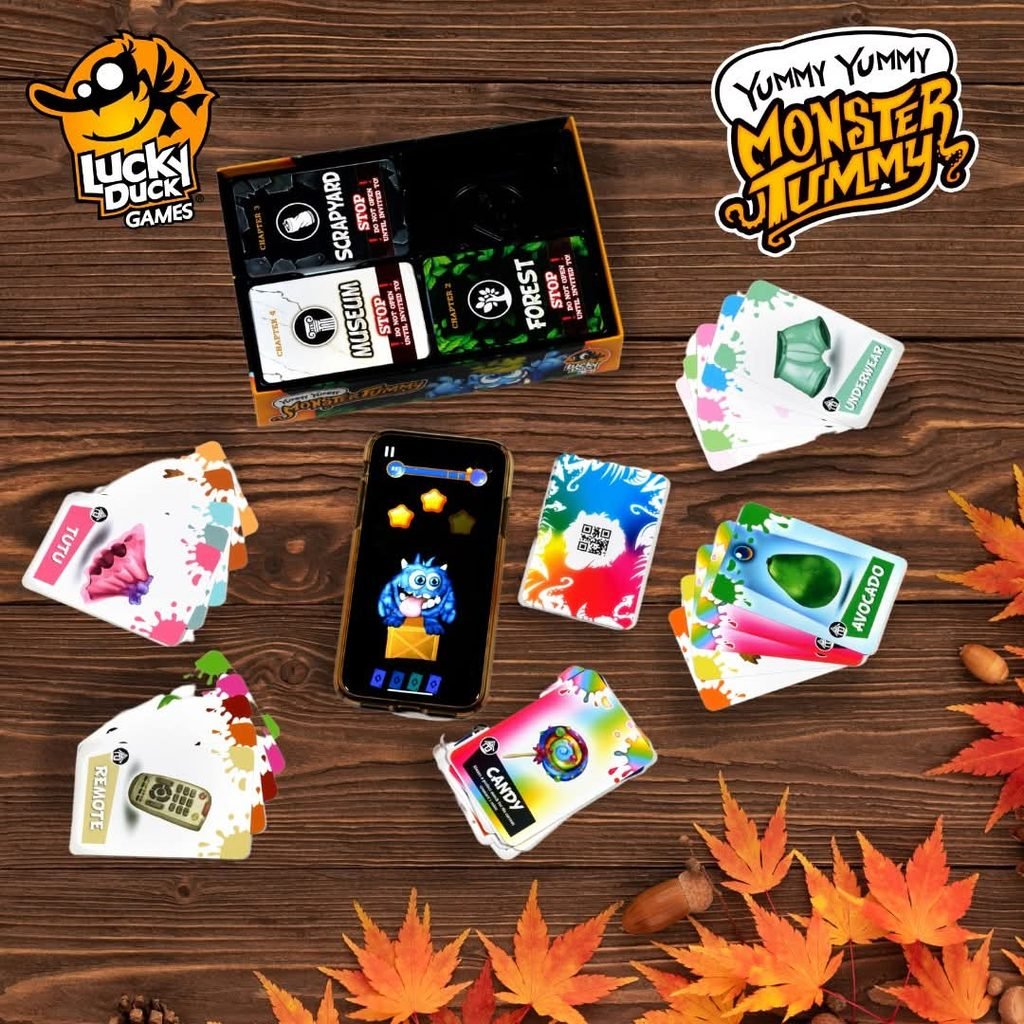
You and your fellow players have discovered a group of friendly, very hungry monsters hiding out in Grandpa’s attic. To keep them happy, you need to feed them whatever everyday objects you can find. Each player holds a hand of item cards showing things like rubber ducks, watering cans, bananas, or old boots, each in a unique colour, with a QR code printed on the back of every card.
The game is driven by a free companion app on a phone or tablet. At the start of a round, a hungry monster pops up on the screen with a specific fur colour. Your goal is to feed it a combination of items whose colours blend together to match that fur. Here is the catch: you can talk to your teammates about what you have in your hand, and you can describe your colours, but you are not allowed to show each other your cards.
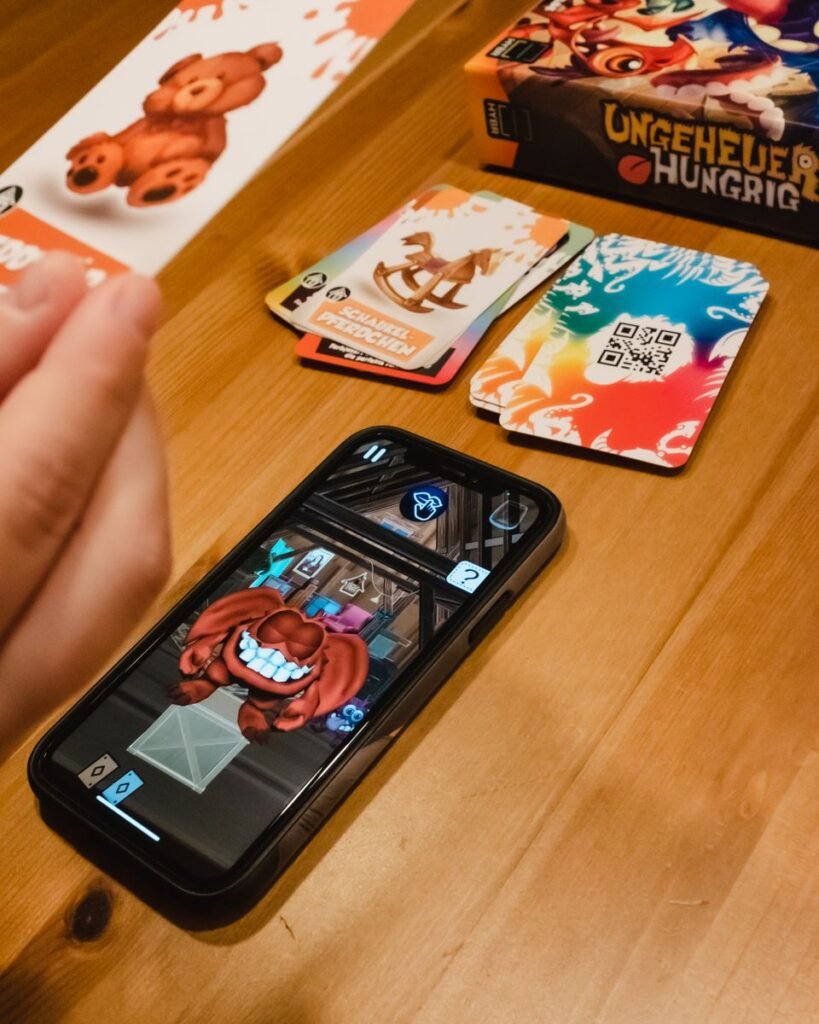
Once you agree on a plan, each player scans one card into the app’s camera. The app gobbles up the items, mixes their colours together on screen, and shows you the result. If the blended colour is close enough to the monster’s fur, it is happy and moves on. If you miss the mark, that’s the end of the game.
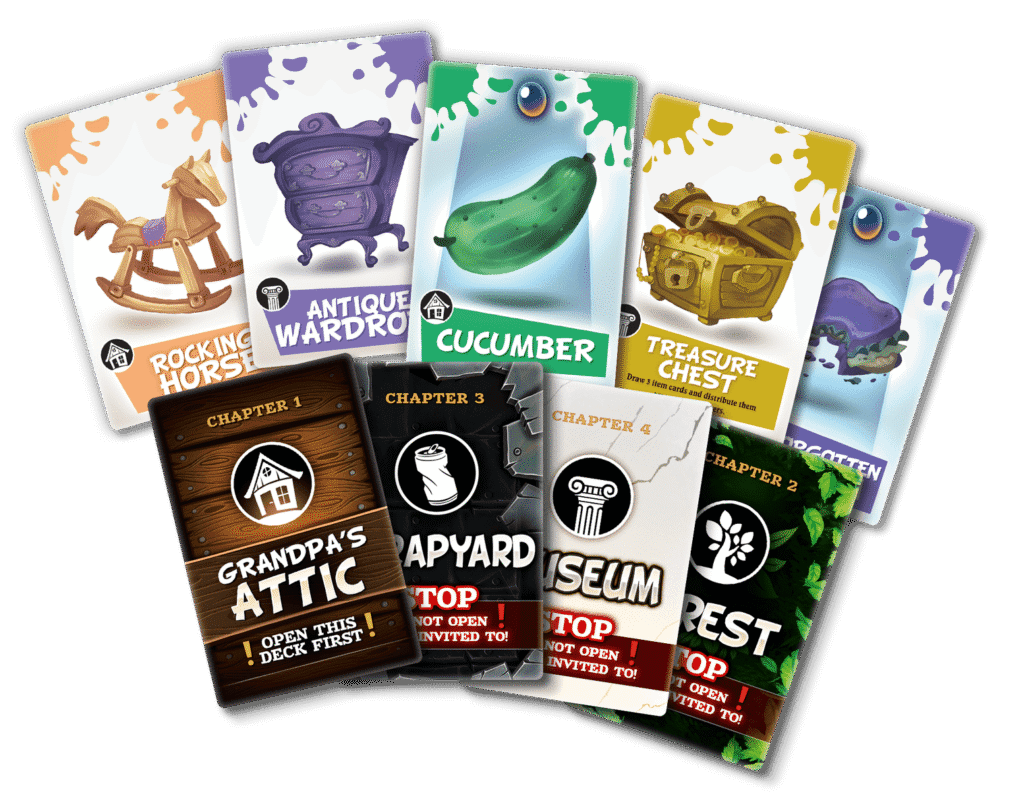
You can play in a quick Party Mode, or dive into the 12-level Story Mode which gradually takes you out of the attic and into new locations like the Forest, the Scrapyard, and the Museum. Each new area unlocks additional cards and creatures which come with new mechanics, such as rabbits only being able to eat vitamin cards or dragons preventing new cards being drawn till they are all fed.
Educational Topics
Exploring colour theory in depth
Most colour-based games for younger audiences stop at basic 1-to-1 matching: find a red card to match a red space. Yummy Yummy Monster Tummy skips straight past that and drops players into genuine colour mixing. Because every player has to contribute a card, you are constantly thinking about how colours interact when combined.
In the early levels, mixing yellow and blue to make green feels intuitive. As you progress, however, the monsters start demanding trickier shades: dusty purples, pale oranges, or muddy browns. Suddenly, players have to think about proportions, brightness, and saturation. If you need a light pink, throwing in a dark crimson and a pale white card will get you much closer than two heavy reds.
From a teaching perspective, this moves learners away from passively memorising a colour wheel and into active experimentation. Better yet, because players cannot show their cards to one another, they are forced to develop a richer vocabulary to describe what they are holding. You quickly hear players move from saying “I have a blue” to “I have a really bright, icy blue that might lighten up your dark green.” That verbal negotiation is where real understanding sticks.
Basic storytelling and narrative building
Whilst the Story Mode gives learners a clear sense of progression as they travel through different locations, what really sparks the imagination are the item cards themselves.
Because the monsters will happily eat almost anything, you end up feeding a purple dragon a combination of a rusty tin can, a slice of watermelon, and a pair of socks. These absurd combinations naturally generate silly, emergent stories around the table.
For educators, this creates a brilliant, low-pressure scaffold for basic storytelling. Facing a blank page can be intimidating for learners of any age, especially when they are still building creative confidence. By using the game’s locations and bizarre meals as prompts, you can pause between rounds and invite learners to fill in the gaps.
- Why is this monster hanging out in a museum?
- How did it develop a taste for old boots?
It turns storytelling into a collaborative, joyful activity rather than a daunting task.
Modern technology as a creative, hands-on learning tool
There has been a lot of discussion and debate lately within education about screen time, and it is easy to assume that bringing a tablet to the table means losing the tactile, social magic of a board game. Yummy Yummy Monster Tummy is a fantastic showcase of how modern technology can do the exact opposite when designed thoughtfully.
This is a great example of “phygital” play, where physical objects and digital tools work together seamlessly. The cards stay in your hands, the conversation happens face to face, and the app quietly handles the heavy lifting in the background. In pedagogical terms, the app helps manage cognitive load. Instead of players getting bogged down in complex rules, scoring tables, or trying to calculate colour percentages on paper, the technology takes care of the complex maths and delivers instant visual and audio feedback.
This frees up learners to focus entirely on experimenting, communicating, and having fun. It also opens up a brilliant meta-conversation with older students about design and technology: how simple tools like QR codes and a basic camera can be combined creatively to build interactive, hands-on learning experiences.
Discussion Prompts

- When you had to mix a tricky shade without showing your cards, what words or comparisons helped your team understand the exact colour you were holding?
- Looking back at the strangest meal we fed a monster today, can you tell a short story about why the monster was in that location and why that bizarre mix tasted so good?
- How did scanning physical cards into the app change the experience compared to a traditional card game, and what other complex topics could we teach using a mix of hands-on objects and simple technology?
Summary
Yummy Yummy Monster Tummy is a wonderful reminder that accessible design does not mean shallow learning. Behind its friendly monsters and approachable rules lies a thoughtful, cooperative experience that turns colour theory into an active conversation, gives budding storytellers a playful launchpad, and proves just how creative hybrid tabletop technology can be. Whether you are working with primary pupils, running a creative workshop with teenagers/adults, or just looking for a clever family game, this one deserves a spot on your shelf.