

Welcome back to Games For All! Today we are looking at an absolute heavyweight in the board gaming world. Brass: Birmingham currently sits near the very top of the BoardGameGeek rankings, and for good reason. Set in the gritty heart of the English Industrial Revolution, it is a masterclass in economic strategy where players step into the shoes of competing entrepreneurs trying to build the most profitable industrial empire.
Before we dive in, I need to add a quick but important proviso. This is a highly complex game, and a full playthrough requires a significant time commitment. Because of this, asking students to play a full game from start to finish might not be practical. Instead, the ideal approach for the classroom is setting up small, curated scenarios. By dropping students into pre-built situations, you can perfectly represent the specific business aspects you wish to demonstrate without the overhead of a three-hour playtime.
How to Play
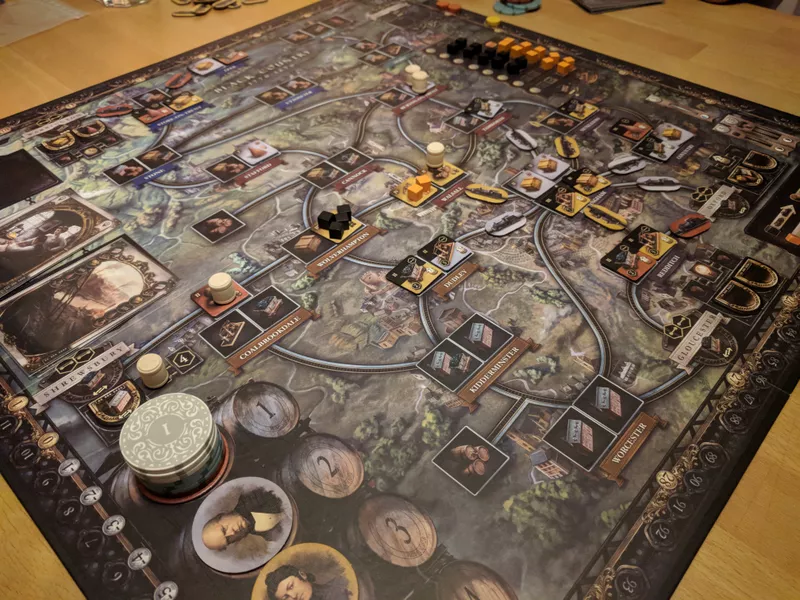
At its core, players take turns playing cards from their hand to build various industries across the map, such as cotton mills, coal mines, iron works, and breweries. However, building an industry is only half the battle. To actually score points and increase your income, you have to connect these industries to markets using transport networks. You start by building canals, but eventually, you will need to upgrade to railways.
The game is split into two distinct halves. The Canal Era represents early industrialisation, where transport is slow and very localized. Halfway through the game, the Rail Era begins. In a brilliant mechanical twist, all of your obsolete canal networks and lower-level industries are wiped off the board. Players must adapt to this sudden technological disruption by rebuilding their logistics networks for a faster, more interconnected economy. The constant tension in the game comes from managing finite resources like coal and iron, and carefully timing when to take out loans to fund your expansion.
Educational Topics
The Industrial Revolution and Technological Disruption

The mid-game transition from canals to rail is a perfect experiential anchor for teaching technological disruption. Students can literally feel the pain of having their carefully planned, expensive canal networks become entirely obsolete in an instant. We can use this feeling to discuss how capital investment shifts during periods of rapid innovation. It is incredibly easy to draw parallels between the 19th-century shift to rail and modern industry shifts, such as the rapid rise and integration of AI.
- How did it feel when your canal network was removed from the board, and how does this mirror modern industries facing sudden technological change?
- Why do you think early industries were so geographically limited compared to the later Rail Era?
Supply Chain and Network Economics
In business, an asset that cannot reach a market has zero value. Brass forces students to realize this the hard way. Building an expensive factory without a connecting rail line to a port is a massive waste of capital. This is where those curated scenarios shine. You can set up a mid-game board state where a student’s network is suddenly blocked by a competitor. This forces them to pivot their logistics strategy on the fly and find a new route to market.
- Describe a moment when another player cut off your transport network. How did you adapt your supply chain?
- What is the real-world equivalent of building an isolated industry with no logistical support?
Resource Constraints and Predicament Management

Coal, iron, and beer are essential for taking actions, but they are finite and highly contested. The game features a shared economy, meaning anyone can use the coal you mine if they are connected to it! Educators can drop students into pre-set “predicament scenarios.” Imagine starting a student off in a round with negative income, high debt, and a severe coal shortage on the board. They must use their business acumen to figure out the most efficient sequence of actions to stabilize their cash flow.
- At what point in the scenario did taking a loan feel like a strategic advantage rather than a desperate measure?
- How did a sudden shortage of iron or beer force you to change your long-term business plan?
Summary
Brass: Birmingham transforms abstract economic theories into a tangible, gripping puzzle. By forcing students to navigate supply chain logistics, technological obsolescence, and shared resource markets, it moves learning from passive reading into active, high-stakes decision making. While a full game is a massive undertaking, utilizing small, tailored scenarios is a brilliant way to let students test their business acumen and see the immediate consequences of their strategic choices.