

Art Society is a fun, 30 to 60 minute game where you spend your turns bidding on artwork to add to your collection, aiming to create the best display in town!
How to play
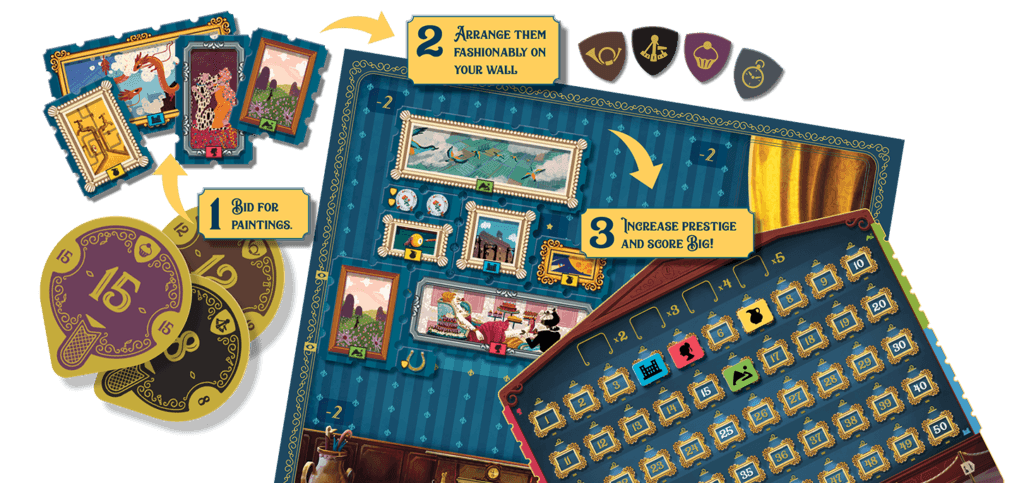
Players start with their playing board – art wall they are working with, 20 numbered bidding cards, and a randomly selected starter artwork which they place touching the starting spots on their wall. They then ranomly draw from the starting bidding cards numbered 1 to 4.
Each turn one player – determined by the lowest bid the previous round, is the auctioneer. They randomly choose a number of artworks (the number of players +1) without looking at them, which will be bid on that turn.
The players then use their bid tokens to decide the order they can choose the artwork. The highest bidder goes first, then the second highest etc. Until you have just 1 painting left which goes on to the museum. Once a bid token is used you cannot use the same token again this game, so keep that in mind whilst playing. When placing your tiles it must touch another painting against a long edge, they cannot be corner to corner and they cannot be separate from one another.
All the panitings have one of 4 frame types and one of for painting types. If paintings of the same type touch one another, they do not score any ‘prestige’ points at the end of the game. However if paintings of the same frame type are touching they gain bonus ‘decor’ tiles which can be used to fill in gaps on you wall, helping you score more points at the end of the game.
You can store up to one painting or decor tile at a time with your ‘assistant’ and place it at a later point if you can’t make a placement without breaching the type rule.
If you collect more paintings than you can display on your wall, they will ocst you points at the end of the game as well.
The paintings that go to the museum increase the prestige value of all paintings of the same painting type. The type in the museum with the highest overall values gives a x5 modifier, then a x4, then a x3 and finally a x2. Also on each board is an ‘eyeline’ band, and any paintings from the x5 type gain an additional 3 points if any part of them fall within that band. If you haven’t filled the corners of your wall you lose 2 points for each, and you lose 2 points for each excess painting you have in your collection as well.
Links to Art and Economics

This game is brilliant for teaching about the effects of both private collections and museums on art. It clearly showcases how having art displayed in a museum increases the value of similar pieces.
Fame/Market Value
You can use it to explore how artwork becomes famous:
- Do those whose art only ends up in private collections reach the same level of fame as those where they are on public display?
- Why is that the case?
- What impact does public interest in a particular style influence the popularity and value of collectibles in the future?
- What other forces drive market value for collectibles?
Artists/Styles
As the artworks included are all pastiches of well known pieces of art you can use that as a launching point to discuss various artists or styles. Perhaps set the game up to only use specific pieces and see how that effects the game.
Displays
You can talk about the importance of variety and theming in displays. Whilst the game itself only provides 2 aspects to consider – the type of frame and the overall type of painting – that doesnt mean that by following the game’s rules you would always create an impressive display. You can use this to explore multiple concepts such as:
- When does a display reach saturation point for a particular style?
- How do you avoid it when crafting collections?
- Would the displays created in the game actually work in reality?
Summary
It is a relatively quick game which can lead to many interesting discussions amongst your students that have a direct correlation to examples they will see in the real world. It allows a safe, risk free exploration of developing private collections and the impact that can have on market forces.