

Is the goal to win? No, the goal is to tell a great story.
In this interview segment, Jon Bernthal speaks with Deborah Ann Woll about Dungeons and Dragons, where he questions if winning is the objective. The realization hits him that the essence of the game lies in creating a great story with friends, navigating strengths and weaknesses along the way.
This perspective resonates with me, as it reflects the nature of games and play. It raises an important question: Isn’t this how education should be?
When did the final exam become the sole focus of education? We often teach to the test, striving for higher rankings on arbitrary league tables, and penalizing teachers when students don’t achieve scores based on assessments they completed half their life ago.
Educational Ideals
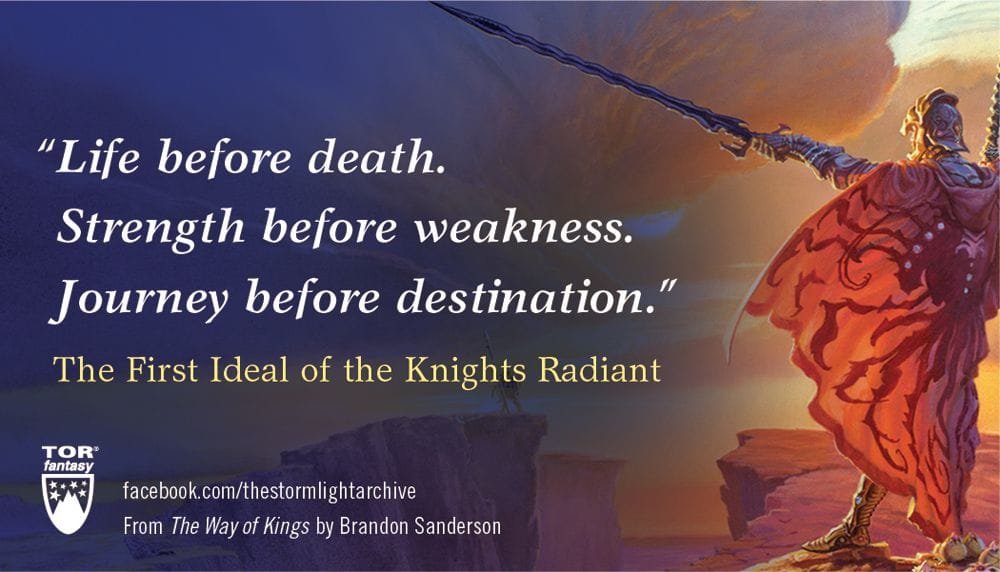
In one of my favourite book series, The Stormlight Archive, the magic on the world of Roshar is powered by oaths binding people to creatures called ‘spren’. Those who swear the oaths are called Knights Radiant and get a variety of abilities based on the spren they bond with. The oaths all differ except for the first one, called the First Ideal:
Life Before Death.
Strength Before Weakness.
Journey Before Destination
I’ve been using that to guide me for years now, since I first read The Way of Kings almost a decade ago. It applies to pretty much everything in life. The journey, is the most important part of anything. The destination is the end point yes, but how you get there will shape not only what the outcome looks like, but what you look like at the end.
How can we shift our focus back to valuing the journey? The exploration and gradual development of understanding should take precedence over merely imparting content knowledge for assessment. We should aim to help students unlock their identities.
The journey is where the lifewide learner is nurtured—someone who finds joy in learning for its own sake in all aspects of their lives (hence lifewide not lifelong). This is the goal of many educators I know. So why isn’t this what education measures?
AI’s impact on assessment
At the 24th Annual Durham Blackboard User Conference (durbbu) this year I was lucky enough to be able to attend the first afternoon and the session I attended was looking at how assessments could/should change to reflect the “new” world of AI we are within. I put “new” in quotation marks because the issues aren’t actually new at all. Prior to AI becoming publicly available, if you had enough money then you could pay someone to do your assessments for you.
It’s such a prevalent activity that it is used in Hollywood blockbusters as a shorthand to show how intelligent a character is. For instance, when we are first introduced to Riri Williams, the tech genius also known as Ironheart, in Black Panther 2 she takes another MIT students phone stating he forgot to Venmo her for the work she did on his assignment.
AI has brought that capability to everyone, regardless of finances, and it is forcing education to address the elephant in the room that they have too long ignored. The single submission of a written academic essay, is not an effective, nor accurate measurement of student’s knowledge of a subject.
To go back to my earlier statement, it is the destination. You can infer understanding from it, yes. You can gauge how well a student can explain concepts and how well read they are on that hyper specific topic. But is it actually providing evidence of learning? Is it providing evidence that the student knows how to gather information in a broader sense around their topic and apply it practically? These questions are less clearly answered, yet we give a certification at the end stating that they can do these things in their topic.
The purpose of assessment
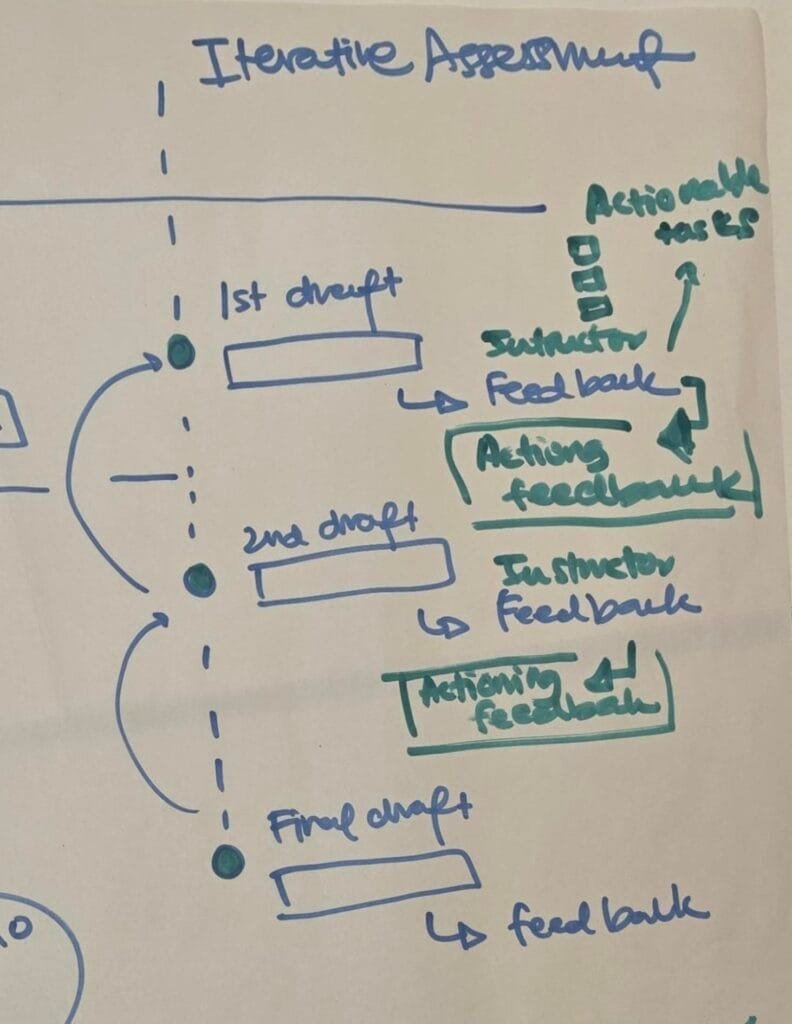
In the session at durbbu the group I was part of was tasked with exploring the concept of Iterative Assessments and how it could work effectively. We came up with the concept of a submission area which enforced multiple draft submissions, with a final submission at the very end. The key, important aspect we identified was the feedback loop that would be integral to it. Each draft needed clear, actionable feedback that students would be expected to build into their process and reflect upon in future drafts. This culminates with their final submission which should have a clear section where the student reflects on their journey throughout the module, identifying not just what they learnt, but how that learning changed their approach/opinion.
This building of assessments as formative, self-reflective tools rather than solely summative, purely academic tools is (to me at least) something we should be aiming for. Unless you end up working in academia, the ability to write a purely academic paper is not going to help much in the roles you go on to complete in the future. With a formative, self-reflective approach you are no only showing you have subject knowledge, but you are also:
- Identifying how you learn,
- Seeing what works for you and what doesn’t
- Exploring your strengths and weaknesses
- Applying revised understanding to a project or piece of work
- Demonstrating how you respond to feedback.
- Demonstrating how you work with others
These types of skills have derisively been called ‘soft skills’ in the past, but are increasingly the key skills modern employers are actively seeking in their employees.
In summary
It is vitally important that we do assess our students knowledge. That is not being called into question at all by me here. However I don’t think the mechanism to truly assess that knowledge has yet been fully formed. Education is a very slow moving beast, similar to a massive container ship. If one of those turns too fast it runs the risk of capsizing. Unfortunately, or fortunately depending on your outlook, AI is like a tidal wave that is forcing the ship to course correct.
I don’t know how easy it will be in practice to apply my thoughts on assessment changes. Lecturers are already pressed for time and adding multiple formative feedback points could well prove to be too much. But there must be a way for us to see the full, unabridged story of our students. To assess their journey whilst with us, as it is how they travel along that journey which is most important to determining where, and what, their destination will be.